Spain continues to attract residents and expatriates from across Europe and beyond, drawn by its climate, healthcare system and quality of life. However, recent data show that the cost of everyday living is placing increasing pressure on household finances.
According to the latest consumer spending analysis, the average Spanish household now spends approximately 21,938 € per year on essential day-to-day expenses. This represents around 66.5% of the average net salary, meaning that nearly two-thirds of take-home pay is absorbed by housing, groceries, utilities and transport before any discretionary spending or savings are considered.
Although Spain remains more affordable overall than major global cities such as London or New York City, the variation within Spain itself has become increasingly significant.
Why Location Matters More Than Ever
The national average of 21,938 € conceals important differences depending on both geography and housing status.
Households with a mortgage devote roughly 65% of their net income to essential expenses. Renters face even greater financial pressure, with costs consuming around 68% of income on average. In some high-demand regions, the proportion is considerably higher.
Housing remains the dominant cost driver. Mortgage or rent payments, combined with community charges and maintenance, account for more than half of essential household expenditure. Annual grocery spending now exceeds 4,000 € per household, while electricity and gas together add more than 1,200 € per year. Telecommunications and other routine services further reduce disposable income.
In practical terms, this leaves limited capacity for savings, particularly in coastal and metropolitan areas where demand continues to outpace supply.
The Most Expensive Places to Live in Spain
Recent regional data from the Roams Consumer Spending Report highlight stark contrasts across the country. The following areas are among the most financially demanding:
- Balearic Islands: In this region, essential living costs can absorb almost 100 per cent of a couple’s combined net income, particularly for renters. Housing pressure is the principal factor.
- Málaga: Once regarded as comparatively affordable, Málaga has experienced sustained rental growth driven by international demand and remote workers. In some cases, renters may see more than 90 per cent of income directed towards essential costs.
- Barcelona: High rental prices combined with daily living expenses keep financial pressure elevated, particularly for younger professionals and single-income households.
- Madrid: Spain’s capital continues to reflect higher housing and service costs. Salaries tend to be stronger than in many other regions, yet essential expenditure still absorbs a significant share of income.
- San Sebastián: High property values and lifestyle-related expenses place this city consistently among the most expensive locations nationally.
In many of these areas, saving or building financial resilience can prove challenging unless household income is substantially above the national average.
The Cheapest Places to Live in Spain
For those prioritising affordability, several inland cities continue to offer more favourable cost-to-income ratios:
- Cáceres: Recognised as the most budget-friendly location overall, with average essential expenses significantly below the national average.
- Zamora: Known for very affordable housing and rental costs, making it a strong choice for cost-conscious residents.
- Ciudad Real: Housing remains accessible relative to larger urban centres.
- Jaén: Another inland option where essential expenditure consumes a smaller proportion of income.
These locations tend to combine accessible housing with lower daily costs, providing more disposable income for residents compared with big urban hubs
What This Means for Residents and Expats
The financial landscape in Spain has shifted. While the country remains comparatively attractive from a European cost perspective, the margin for savings has narrowed considerably.
With approximately two-thirds of net income now devoted to essentials at the national level, location plays a decisive role in determining financial sustainability.
Retirees and remote workers may find that inland cities offer greater budget resilience and lower exposure to rental volatility. Young professionals and families may continue to prioritise larger urban centres for employment opportunities and infrastructure, but must weigh these advantages against significantly higher essential expenditure.
Careful regional research is therefore no longer optional. It is central to maintaining long-term financial stability.
Spain in an International Context
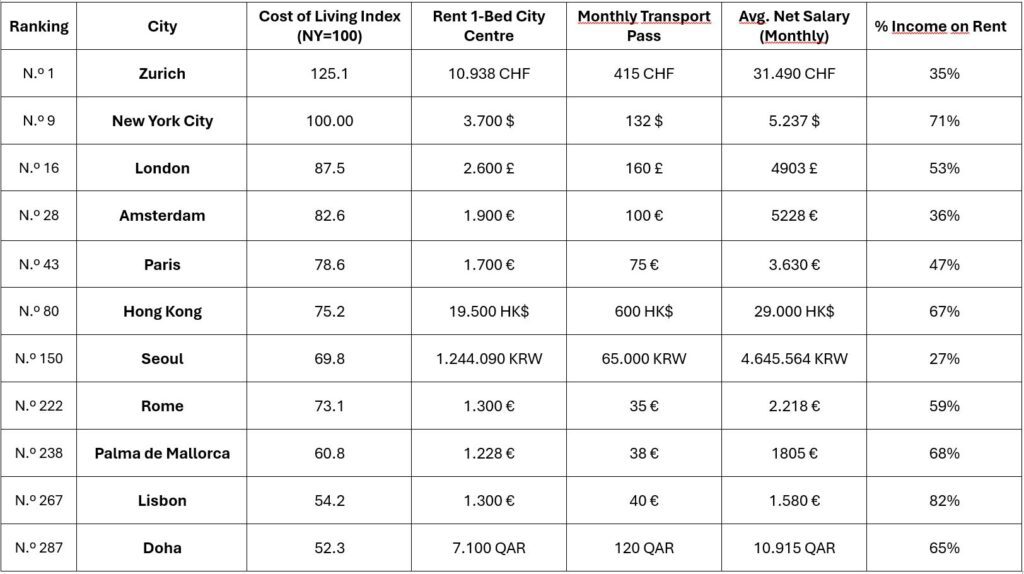
To put cost differences into perspective, Numbeo, an online database that aggregates user-reported data on prices, rents and living expenses worldwide, provides comparative data on essential living costs across major global cities, illustrating how far salaries and everyday expenses stretch in each location. The first Spanish city to appear in the ranking is Mallorca, and only at position N.º 238.
Bottom Line: Location Is Everything
Spain remains more affordable than many high-profile global cities. However, the data demonstrate clearly that essential living costs are rising and that internal regional disparities are widening.
The average household now spends approximately 21,938 € per year on basic necessities, equivalent to 66.5% of net income. In certain regions, particularly high-demand coastal areas, the proportion is considerably higher.
Choosing where to live in Spain is no longer purely a lifestyle decision. It is increasingly a financial strategy.
In 2026, location does not simply determine climate or scenery. It determines how much of your income you retain, how much you can save and how secure your financial future will be.