In today’s competitive employment landscape, offering attractive compensation packages is more important than ever. Flexible salary arrangements have emerged as a forward-thinking strategy that not only enhances employee satisfaction but also optimizes tax efficiency. These arrangements allow companies to offer non-monetary benefits to their employees, such as health insurance, childcare, and pensions, without incurring additional costs.
The advantages of flexible salary systems are multifaceted. For employees, they provide valuable financial relief by reducing taxable income, resulting in increased take-home pay. For companies, they create opportunities to structure remuneration packages that attract and retain talent, all while remaining cost-neutral.
Flexible salary benefits (benefits in-kind income), under Spanish legislation are subject to specific regulatory limits. Notably, the tax-exempt portion of flexible salary cannot exceed 30% of an employee’s gross annual salary, as outlined in the applicable regulations. By understanding these legal provisions, businesses can design compensation models that comply with the law while maximizing their effectiveness.
Below, we detail the key tax-exempt benefits available under flexible salary systems and explore how pension contributions can offer dual advantages for both employers and employees.
Tax-exempt benefits in flexible salary systems
- Health Insurance
Health insurance can be provided as a benefit in-kind with the following tax exemptions:
• Up to 500€ per year for each insured individual (employee, spouse, and children).
• Up to 1,500€ per year for individuals with disabilities.
Amounts exceeding these thresholds are subject to tax and social security contributions. - Meals
Employees can receive meal allowances or access company canteens with the following conditions:
• Services must be provided on working days.
• The tax-exempt limit is 11€ per day.
• Amounts exceeding this limit are subject to tax and social security contributions. - Childcare
Childcare services, including nursery education in approved centres, are tax-exempt with no monetary limit. These services can be provided directly by the company or through authorised third parties.
The company covers childcare costs upfront, deducting them from the employee’s pay check. Although the expense is ultimately paid by the employee, the IRPF tax exemption makes it highly advantageous. - Public Transport
Public transport allowances for commuting between home and work are tax-exempt up to 1,500€ per year. Amounts above this cap are subject to taxation and social security contributions. - Training
Training programs for professional development, retraining, or qualification updates are also exempt from taxation. Unlike other benefits, there is no monetary limit on this exemption, making it an invaluable option for employees and companies alike.
Important Considerations
Although these flexible salary benefits are tax-exempt, they are still subject to social security contributions. As such, the primary advantage lies in the tax savings provided to employees rather than direct financial savings for the company.
A Dual-Benefit Option: Pension Contributions
Unlike other flexible salary benefits, pension contributions stand out because they offer tax advantages for both employees and employers. By integrating pension plans into remuneration structures, companies can achieve financial benefits while enhancing employee security and satisfaction.
Benefits for Companies
- Corporation tax deductions
Companies can deduct 10% of contributions made for employee’s earnings below 27,000€ gross annually, calculated as:
Deduction = Company contribution × 10% × (27,000€ / Gross salary)
For employees earning more than 27,000€, the deduction is proportionally reduced. - Social Security Contribution Reductions
Pension contributions made by companies are deductible from their social security obligations, with a maximum reduction of 1,428€ per year or 119€ per month per employee.
Benefits for Employees
- Income tax base reduction
Employees can reduce their taxable income (IRPF tax base) by up to 8,500€ per year for combined contributions from both the employer and employee to a company pension plan.
This setup allows employees to enjoy lower tax withholdings and higher take-home pay while building their long-term financial security.
Estimated Savings with a 5% Pension Contribution
To illustrate the benefits, consider the case of an employee earning 35,000€ annually with a company pension contribution of 5% (1.750€/year). Below is a comparison of their net income under a flexible salary arrangement versus a standard salary structure:
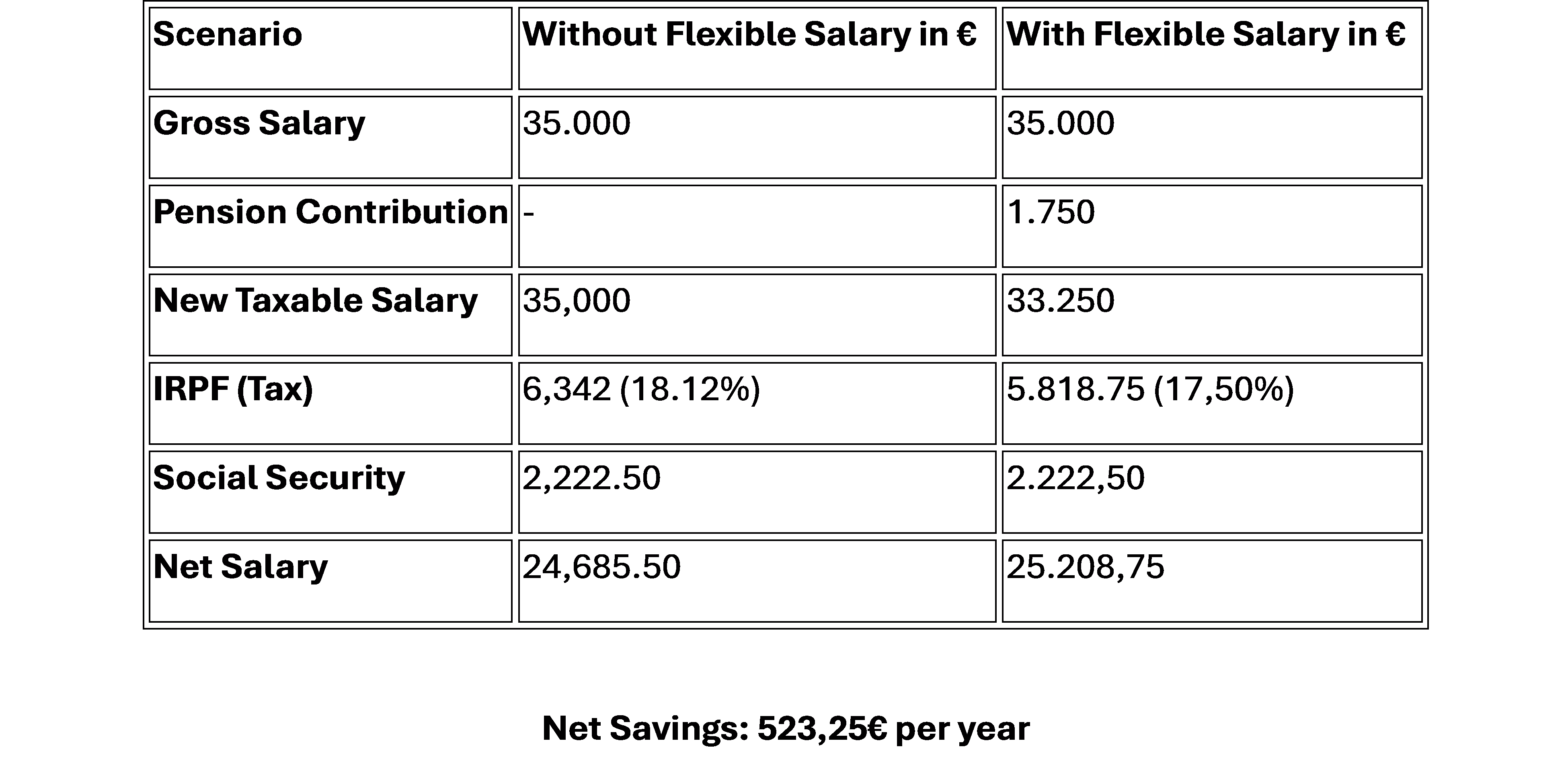
Employees will see reduced retentions on their payslips, leading to higher take-home pay due to the tax incentives.
From the company’s perspective, considering the example above, the savings would include:
• Corporation tax savings: Up to 1,280€ would be allowed for deduction.
• Social security savings: Up to 1,428€ would be allowed for deduction.
By incorporating pension contributions into flexible salary arrangements, companies can not only enhance employee compensation but also optimise their own tax and social security obligations. This dual-benefit system strengthens financial outcomes for both parties, making it a powerful tool for modern remuneration strategies.
Conclusion
Flexible salary systems provide a valuable opportunity for companies to enhance employee satisfaction while optimising remuneration strategies. By incorporating a range of tax-efficient benefits, including health insurance, childcare, and public transport allowances, organisations can support their employees’ financial and personal well-being without incurring additional costs.
Among these options, pension contributions stand out as a truly dual-benefit solution. They allow employees to save for the future with significant tax advantages while enabling companies to reduce corporation tax and social security contributions. This balance of individual and organizational benefits creates a win-win scenario that aligns with both employee needs and business goals.
As the modern workforce continues to prioritise financial security and personalised benefits, adopting flexible salary systems demonstrates a company’s commitment to innovation and employee care. With careful planning and adherence to legal guidelines, businesses can utilise this remuneration approach to attract and retain top talent while cultivating a culture of shared success.